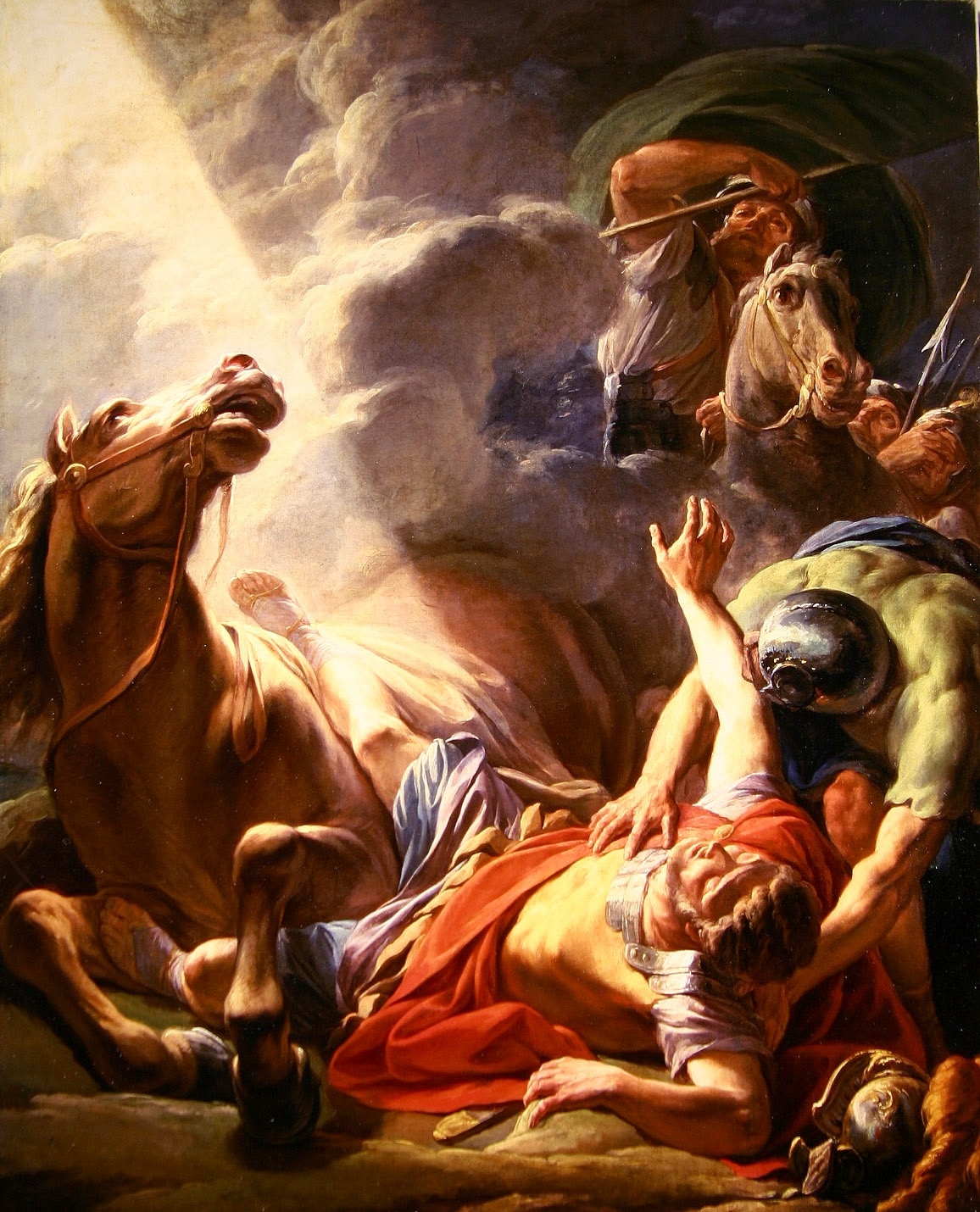
"Therefore, since we are surrounded by so great a cloud of witnesses… let us run with perseverance." (Hebrews 12:1)
Grief · The Pierced Heart
Our Lady of Sorrows
Memorial · September 15
The Blessed Mother did not suffer at a distance. Simeon prophesied that a sword
would pierce her own soul, and it did: in the flight into Egypt, in the losing of
her Child, in meeting Him on the road to Calvary, in standing at the foot of the
Cross, in receiving His body, in laying Him in the tomb. The Church counts her
seven sorrows. She is the mother of everyone whose grief has no words.
Pray with the Blessed Mother
Her page holds her novenas and her prayers: the Novena in Honor of Our Lady
of Sorrows, the Novena to Mary, Undoer of Knots, the Seven Sorrows Chaplet,
and the Angelus.
"…and you yourself a sword will pierce…"
The prophecy of Simeon, Luke 2:35 (NABRE)
Spiritual Darkness · Feeling Abandoned by God
St. Teresa of Calcutta
Memorial · September 5
The world saw her smile. Her private letters, published after her death as
Come Be My Light, revealed that for roughly the last half-century of her
life she lived in an almost unbroken interior darkness, a felt absence of the God
she served every day. She kept loving. She kept serving. She was canonized in 2016.
"I am told God loves me — and yet the reality of darkness and coldness and
emptiness is so great that nothing touches my soul."
Come Be My Light, her private writings
Suffering in an Evil Place · Martyrdom of Charity
St. Maximilian Kolbe
Memorial · August 14
A Franciscan priest imprisoned in Auschwitz. In July 1941, when ten prisoners were
condemned to die of starvation as a reprisal, one of them, Franciszek Gajowniczek,
cried out for his wife and children. Kolbe stepped forward and asked to take his
place. He spent two weeks in the starvation bunker leading the condemned in prayer,
and died on August 14, 1941. Gajowniczek survived, and stood in St. Peter's Square
when Kolbe was canonized in 1982.
"Do not worry for me and for my health, because the good God is in every place and
with great love He thinks about everyone and everything."
From his last letter to his mother, written from Auschwitz, 1941
The Dark Night · Imprisonment · Betrayal
St. John of the Cross
Memorial · December 14
In 1577 he was seized in the night by his own religious brothers, who opposed his
reform, and locked in a tiny cell in Toledo. Nine months of darkness, hunger, and
isolation followed. In that cell he composed some of the greatest mystical poetry the Church
possesses. He is the Church's great teacher of the dark night: the terrible,
purifying seasons when God feels absent and is, in truth, closest.
"At the evening of life, you will be examined in love. Learn to love as God desires
to be loved and abandon your own ways of acting."
Sayings of Light and Love
Trial of Faith · The Night of Nothingness
St. Thérèse of Lisieux
Memorial · October 1
From Easter 1896 until her death in September 1897, the saint of the Little Way
lived the last eighteen months of her life in a trial of faith she could only
call a dark tunnel. Dying of tuberculosis at twenty-four, tempted against the
existence of heaven itself, she chose to sit at the table of bitterness with
sinners and keep believing in love. She wrote it all down in
Story of a Soul.
"He allowed my soul to be overwhelmed with darkness, and the thought of Heaven,
which had consoled me from my earliest childhood, now became a subject of conflict
and torture… One must have passed through this dark tunnel to understand its
blackness."
Story of a Soul, "The Night of the Soul"
Mental Illness · Anxiety
St. Dymphna
Feast · May 15
A seventh-century Irish girl who fled her disturbed father's violence and was
martyred by his hand at Geel, in Belgium. Around her shrine, for centuries, the
people of Geel took the mentally ill into their own homes. It became one of the
oldest continuous traditions of humane care for mental illness in the world. She is the
patron of those who suffer mental illness, anxiety, and emotional distress.
Scrupulosity · Despairing Thoughts
St. Ignatius of Loyola
Memorial · July 31
At Manresa, the soldier-turned-pilgrim was tormented by scruples, the obsessive,
circling fears about his sins that no confession could quiet. His autobiography
records that the anguish grew so severe he was tempted to end his life. God led
him through that darkness, and out of it came the Spiritual Exercises and the
Church's great school of discernment.
"O Lord, help me, for I find no remedy among men, nor in any creature! If I thought
I could find one, no labor would seem too great to me."
His cry at Manresa, from the Autobiography of St. Ignatius
Rejection · Homelessness · Mental Affliction
St. Benedict Joseph Labre
Feast · April 16
He tried again and again to enter religious life, with the Trappists, the
Carthusians, the Cistercians, and was turned away every time. So he became a pilgrim with no home
at all, walking to the shrines of Europe, owning nothing but rags and a few books,
sleeping in the ruins of Rome. He died in 1783, and Rome buried him like a saint.
He is a patron of the homeless and of those who live with mental illness.
"I will always have the fear of God before my eyes and His love in my heart."
From a letter to his parents
Widowhood · The Death of Children · Grief
St. Elizabeth Ann Seton
Memorial · January 4
She lost her mother at three, her husband at thirty, and later two of her
daughters. Out of a life shaped by loss she founded the Sisters of Charity and the
beginnings of Catholic education in America, and in 1975 became the first
American-born canonized saint. Her holiness was not the absence of grief. It was
fidelity inside it.
"Afflictions are the steps to heaven."
Elizabeth Bayley Seton, Collected Writings
Defender · Protector of the Afflicted
St. Michael the Archangel
Feast of the Archangels · September 29
Not a human saint but an archangel, the great defender named in Scripture, who
contends against the enemy of souls. For those whose darkness feels like an
assault, whose minds are a battlefield of intrusive and accusing thoughts, the
Church has always pointed to Michael. In 1884, Pope Leo XIII wrote his famous
prayer and ordered it prayed in churches throughout the world. You do not fight
alone.
"St. Michael the Archangel, defend us in battle. Be our defense against the
wickedness and snares of the devil."
The St. Michael Prayer of Pope Leo XIII, 1884
Scrupulosity · Interior Trials
St. Alphonsus Liguori
Memorial · August 1
Doctor of the Church, founder of the Redemptorists, and the Church's gentlest
moral theologian, and he himself battled scrupulosity through his long life. He is
invoked against scrupulosity and is the patron of confessors, named so precisely
because he understood, from the inside, the mind that torments itself.
"The time of aridity is the best time to practice resignation to God's holy will."
Uniformity with God's Will